
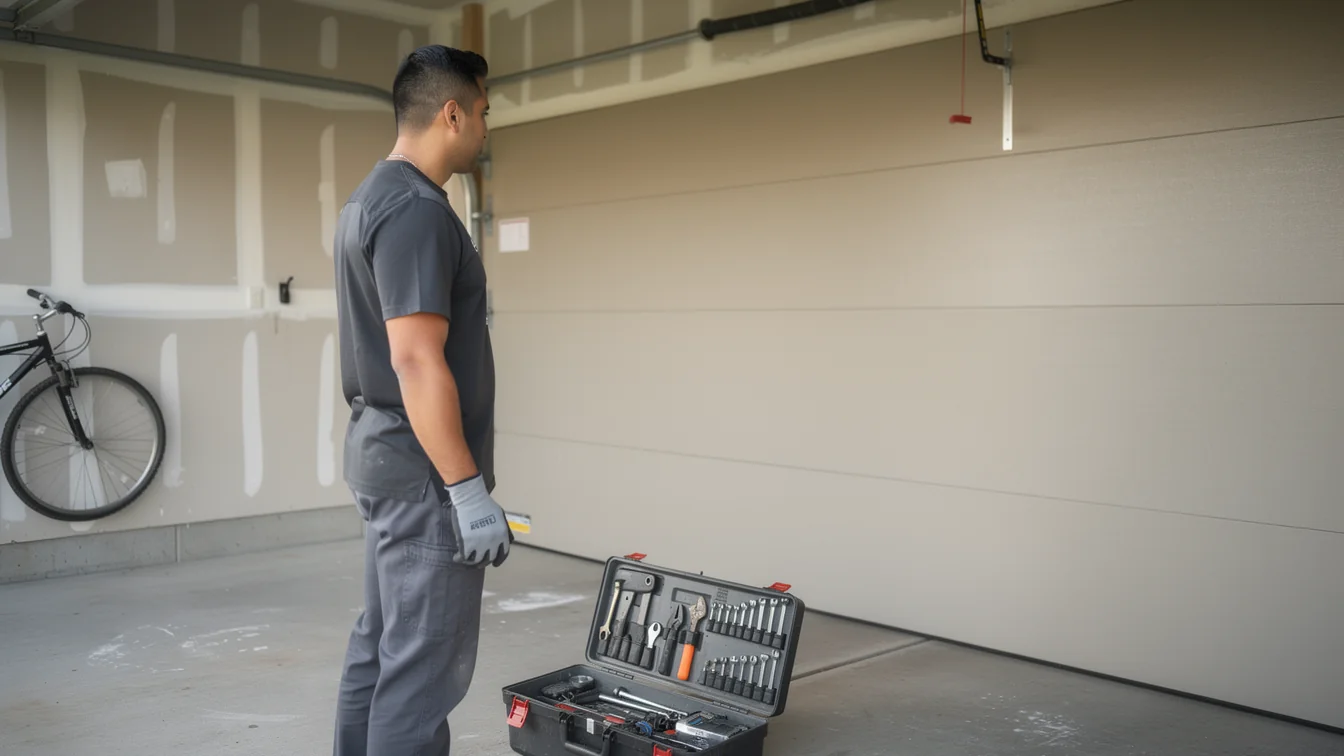
Golden, CO · Garage Door Service
What a Service Call Actually Covers Around Golden
A look at what a garage door service call in Golden actually involves, from the area's 1960s-70s housing stock to the cold-climate wear on springs and tracks.
- Repairs & new doors
- Springs & openers
- Serving 8 nearby communities
Doing Nothing For Now
Not every noisy door needs a truck. If your door is slow to close in January but fine by March, that's the cold doing what cold does to steel and lubricant, not a failure. A lot of the houses we see here went up between 1938 and 1997, with the bulk clustered in the 1960s and 70s, and that generation of door hardware was built with wider tolerances than what's sold today. A little stiffness on the coldest mornings is normal wear, not a reason to call. Where it stops being fine: if the door reverses on its own, if you hear a bang from the spring area, or if one side of the door sits visibly lower than the other. Those aren't seasonal quirks, they're mechanical ones, and waiting on them usually turns a spring job into a spring-and-track job. Our honest limit here: we can tell you over the phone what's probably going on, but we won't guess a cause without seeing the door, and we're not going to talk you into a call you don't need. If the door is doing its job, let it.
What Local Conditions Do
This area sits in a severe cold climate band, and that matters more for garage doors than people expect. Torsion springs lose tension as steel contracts in cold, so a spring that was marginal in October can snap in a January cold snap with no warning. Nylon rollers crack faster here than in milder climates; steel rollers hold up better but transmit more noise through cold concrete slabs. Because so much of the housing stock here dates to 1938-1997 with a lot of it from the 60s and 70s, we're regularly working on original or near-original hardware: single-wall doors, lighter-gauge tracks, and springs sized to a lower cycle count than current doors use. None of that means the door is unsafe, but it does mean the parts age out on a different schedule than a door installed last decade. A service call in this area is as much about checking spring wind and roller condition for the cold months as it is about fixing what's already broken.
What It Costs
We're not going to put a number here we can't stand behind, and prices move with the part, the door's age, and what the job actually turns into once we're under it. What we can tell you is what drives the cost up or down. A door from the 1960s-70s stock common in this area often needs a spring sized differently than what's on the shelf for a modern door, which can mean a slightly longer job, not a pricier part. Cold-weather calls can run longer too, since steel contracts and bolts that would back out easily in summer sometimes don't. The honest trade-off: on a door old enough that the track, springs, and opener are all near the end of their life at once, a repair quote and a replacement quote can land close enough that replacement is the better dollar. We'll tell you when we see that, rather than patching a door that's going to call us back in six months.
The Situation
We work out of Golden and cover the surrounding area, from West Pleasant View and Applewood a couple miles out to places like Evergreen, Idledale, and Morrison further into the foothills, plus the mountain communities like Kittredge, Black Hawk, and Idaho Springs. A service call starts with us looking at the door as a system, not a single part: spring tension, cable wear, track alignment, and opener settings all get checked, because in a cold climate one weak point usually stresses the others. With roughly 29,867 owner-occupied houses across a service area of about 61,414 households, we see a wide range of door ages and setups, and median household income here sits around $108,729, which tends to mean owners replace rather than limp a door along once it's clearly failing. We'll walk you through what we find before we touch anything, and if the fix is small, we'll say so.
Frequently asked questions
How often should I get my garage door serviced in Golden's climate?
Once a year is reasonable for most doors here, ideally before the cold sets in, since torsion springs and rollers take the brunt of winter stress. If your door is original to a 1960s or 70s build, a yearly check catches hardware fatigue before it turns into a snapped spring on a cold morning.
Why did my door get stiff and slow in winter?
Cold steel loses some spring tension and grease thickens, so the door's counterbalance is weaker right when you need it most. It's common on older hardware typical of this area's housing stock and usually isn't an emergency, but a door that reverses or bangs is a different story and worth a call.
Is it worth repairing an old door or replacing it?
Depends what's wearing out. If it's just a spring or a roller on an otherwise sound door, repair makes sense. If the track, springs, and opener are all near end of life together, which happens on houses from the 1938-1997 era, a repair and a replacement can cost about the same, and replacement is usually the smarter call.
Related garage door services in Golden
More garage door guides
Book garage door service in Golden
Call now or request a quote - tell us what the door is doing and where you are.